
Integrations
Your agents, your OS, your providers
27 coding agents and editors, four operating system targets, and a list of LLM and embedding providers that you can ignore, because everything works without one.
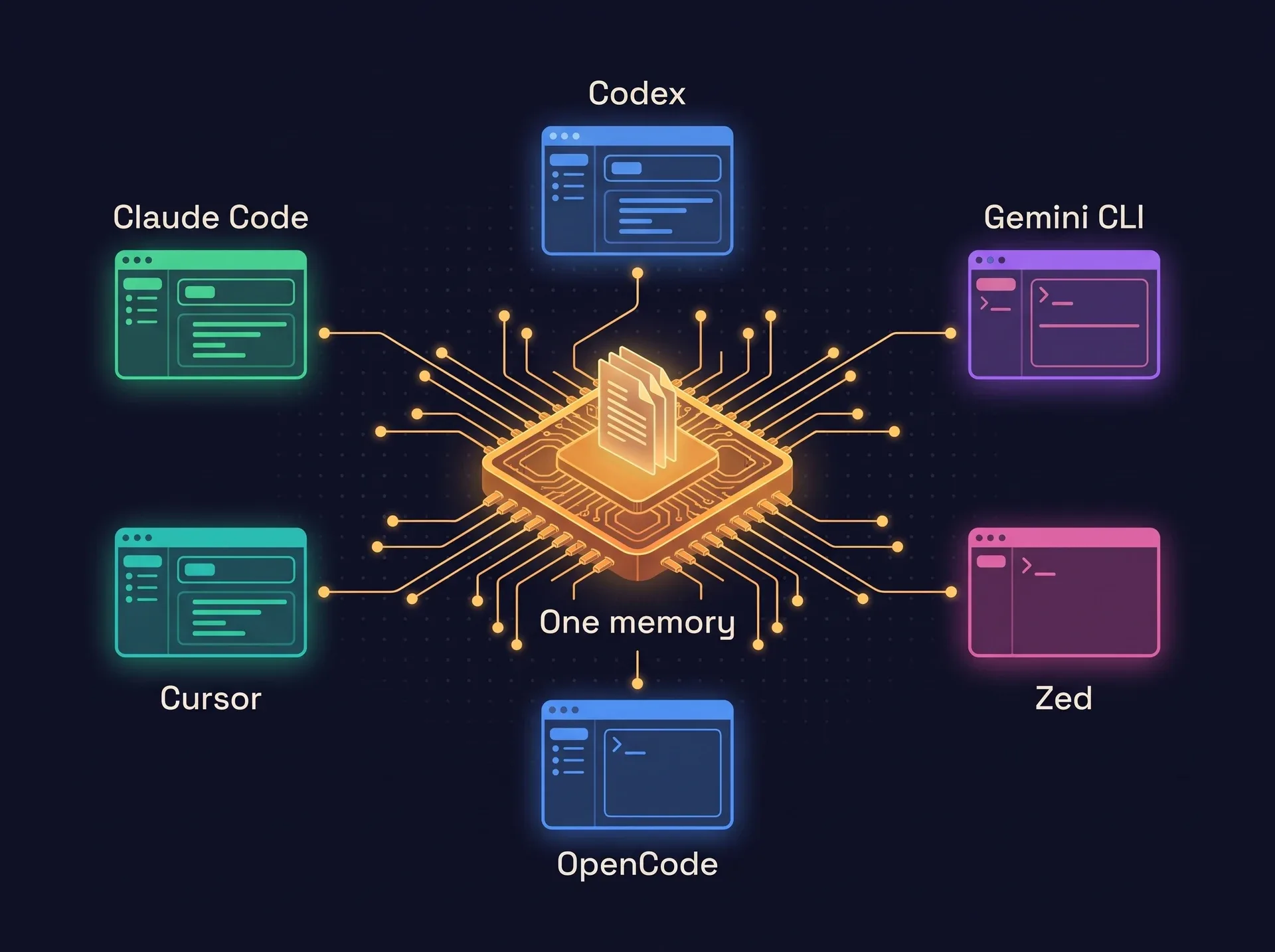
Many agents, one memory
Each agent connects to the same server. What Claude Code learned this morning is there when you open Codex this afternoon.
Agents and editors
Filter by status, then pick a row to get its install commands.
Claude Code Supported
# launch it through ai-memory; the first launch installs its hooks and MCP entry
ai-memory run claude

# or wire it by hand, for a harness you never launch this way
ai-memory install-mcp --client claude-code --apply
ai-memory install-hooks --agent claude-code --apply
Hooks and MCP. Optional session-aware routing. Leave out --apply to print the change without writing it.
Codex Supported
# launch it through ai-memory; the first launch installs its hooks and MCP entry
ai-memory run codex

# or wire it by hand, for a harness you never launch this way
ai-memory install-mcp --client codex --apply
ai-memory install-hooks --agent codex --apply
Hooks and MCP. Session end is wired from Codex CLI 0.145.0. Leave out --apply to print the change without writing it.
Cursor Supported
# the memory tools, over MCP
ai-memory install-mcp --client cursor --apply
# automatic capture, through lifecycle hooks
ai-memory install-hooks --agent cursor --apply
MCP config and lifecycle hooks. Leave out --apply to print the change without writing it.
Gemini CLI Supported
# the memory tools, over MCP
ai-memory install-mcp --client gemini-cli --apply
# automatic capture, through lifecycle hooks
ai-memory install-hooks --agent gemini-cli --apply
MCP config and lifecycle hooks. Leave out --apply to print the change without writing it.
OpenCode Supported
# launch it through ai-memory; the first launch installs its hooks and MCP entry
ai-memory run opencode

# or wire it by hand, for a harness you never launch this way
ai-memory install-mcp --client opencode --apply
ai-memory install-hooks --agent opencode --apply
V1 or V2, detected from the executable. Leave out --apply to print the change without writing it.
OpenCode 2 Supported
# launch it through ai-memory; the first launch installs its hooks and MCP entry
ai-memory run opencode2

# or wire it by hand, for a harness you never launch this way
ai-memory install-mcp --client opencode2 --apply
ai-memory install-hooks --agent opencode2 --apply
Forces V2 when you do not want detection. Every finished turn refreshes the summary and the handoff. Leave out --apply to print the change without writing it.
Grok Build CLI Supported
# launch it through ai-memory; the first launch installs its hooks and MCP entry
ai-memory run grok

# or wire it by hand, for a harness you never launch this way
ai-memory install-mcp --client grok --apply
ai-memory install-hooks --agent grok --apply
Capture works. The handoff arrives with the first tool call. Leave out --apply to print the change without writing it.
GitHub Copilot CLI Supported
# the memory tools, over MCP
ai-memory install-mcp --client copilot-cli --apply
# automatic capture, through lifecycle hooks
ai-memory install-hooks --agent copilot-cli --apply
Ten hook events and MCP. The handoff arrives in Copilot’s additional context at session start. Leave out --apply to print the change without writing it.
Devin CLI Supported
# the memory tools, over MCP
ai-memory install-mcp --client devin --apply
# automatic capture, through lifecycle hooks
ai-memory install-hooks --agent devin --apply
Hooks and MCP, including post-compaction capture. Leave out --apply to print the change without writing it.
Kimi Code Supported
# launch it through ai-memory; the first launch installs its hooks and MCP entry
ai-memory run kimi

# or wire it by hand, for a harness you never launch this way
ai-memory install-mcp --client kimi-code --apply
ai-memory install-hooks --agent kimi-code --apply
Ten hook events. Handoffs inject on the first prompt. Leave out --apply to print the change without writing it.
Kiro CLI Supported
# launch it through ai-memory; the first launch installs its hooks and MCP entry
ai-memory run kiro

# or wire it by hand, for a harness you never launch this way
ai-memory install-mcp --client kiro-cli --apply
ai-memory install-hooks --agent kiro-cli --apply
Both the v2 and v3 engines. Closes on exit under ai-memory run. Leave out --apply to print the change without writing it.
Command Code Supported
# launch it through ai-memory; the first launch installs its hooks and MCP entry
ai-memory run command-code

# or wire it by hand, for a harness you never launch this way
ai-memory install-mcp --client command-code --apply
ai-memory install-hooks --agent command-code --apply
MCP and four hook events, with native resume. Closes on exit under ai-memory run. Leave out --apply to print the change without writing it.
Antigravity CLI Supported
# launch it through ai-memory; the first launch installs its hooks and MCP entry
ai-memory run antigravity

# or wire it by hand, for a harness you never launch this way
ai-memory install-mcp --client antigravity-cli --apply
ai-memory install-hooks --agent antigravity-cli --apply
Under ai-memory run the session closes on exit. Otherwise, finalize-session. Leave out --apply to print the change without writing it.
Pi Supported
# the memory tools, over MCP
ai-memory install-mcp --client pi --apply
# automatic capture, through lifecycle hooks
ai-memory install-hooks --agent pi --apply
A generated extension gives capture and an MCP bridge. Leave out --apply to print the change without writing it.
Oh My Pi Supported
# the memory tools, over MCP
ai-memory install-mcp --client omp --apply
# automatic capture, through lifecycle hooks
ai-memory install-hooks --agent omp --apply
Native MCP and a TypeScript extension. Leave out --apply to print the change without writing it.
OpenClaw Supported
# the memory tools, over MCP
ai-memory install-mcp --client openclaw --apply
# automatic capture, through lifecycle hooks
ai-memory install-hooks --agent openclaw --apply
MCP config and native plugin hooks. Leave out --apply to print the change without writing it.
Zero Supported
# the memory tools, over MCP
ai-memory install-mcp --client zero --apply
# automatic capture, through lifecycle hooks
ai-memory install-hooks --agent zero --apply
Capture includes subagent events. In Zero’s global sandbox settings, allow network and writes to the ai-memory data directory, or deliver queued events with ai-memory hook-drain from a normal shell. Leave out --apply to print the change without writing it.
ZCode Supported
# the memory tools, over MCP
ai-memory install-mcp --client zcode --apply
# automatic capture, through lifecycle hooks
ai-memory install-hooks --agent zcode --apply
Six triggers. Handoff injection works. Leave out --apply to print the change without writing it.
GrizzyBot Supported
# nothing to install: it talks to /hook and /mcp itself
A native macOS agent app with its own ai-memory bridge. Nothing to install. Leave out --apply to print the change without writing it.
Crush Managed-only
# launch it through ai-memory; the first launch installs its hooks and MCP entry
ai-memory run crush
Launch it with ai-memory run crush.
Pool Hooks-only
# stages the hook scripts and prints a snippet to paste into the agent’s settings
ai-memory install-hooks --agent pool --apply
Paste a generated hooks snippet into its settings.
Claude Desktop MCP-only
# the memory tools, over MCP
ai-memory install-mcp --client claude-desktop --apply
Chat uses mcp-remote on macOS, Windows and Linux (beta). Local Code-tab sessions use Claude Code hooks; install them with ai-memory install-hooks --agent claude-code --apply. Cowork capture is unverified. Leave out --apply to print the change without writing it.
VS Code Copilot MCP-only
# the memory tools, over MCP
ai-memory install-mcp --client vscode-copilot --apply
Copilot exposes no lifecycle hooks yet. Leave out --apply to print the change without writing it.
Zed MCP-only
# the memory tools, over MCP
ai-memory install-mcp --client zed --apply
Registered as a context server. Leave out --apply to print the change without writing it.
Swival CLI MCP-only
# the memory tools, over MCP
ai-memory install-mcp --client swival --apply
Project-level MCP config. Leave out --apply to print the change without writing it.
Muse Code MCP-only
# the memory tools, over MCP
ai-memory install-mcp --client muse --apply
User-level MCP settings. Leave out --apply to print the change without writing it.
Hermes Agent Supported
# prints a hooks block to paste into the agent’s own config
ai-memory install-hooks --agent hermes --server-url http://127.0.0.1:49374
The hook installer prints a block for ~/.hermes/config.yaml. Recall and handoffs come from the community plugin. Leave out --apply to print the change without writing it.
| Agent | Status | Notes | ai-memory run |
|---|---|---|---|
| Supported | Hooks and MCP. Optional session-aware routing. | Managed | |
| Supported | Hooks and MCP. Session end is wired from Codex CLI 0.145.0. | Managed | |
| Supported | MCP config and lifecycle hooks. | Direct launch | |
| Supported | MCP config and lifecycle hooks. | Direct launch | |
| Supported | V1 or V2, detected from the executable. | Managed | |
| Supported | Forces V2 when you do not want detection. Every finished turn refreshes the summary and the handoff. | Managed | |
| Supported | Capture works. The handoff arrives with the first tool call. | Managed | |
| Supported | Ten hook events and MCP. The handoff arrives in Copilot’s additional context at session start. | Direct launch | |
| Supported | Hooks and MCP, including post-compaction capture. | Direct launch | |
| Supported | Ten hook events. Handoffs inject on the first prompt. | Managed | |
| Supported | Both the v2 and v3 engines. Closes on exit under ai-memory run. | Managed | |
| Supported | MCP and four hook events, with native resume. Closes on exit under ai-memory run. | Managed | |
| Supported | Under ai-memory run the session closes on exit. Otherwise, finalize-session. | Managed | |
| Supported | A generated extension gives capture and an MCP bridge. | Managed | |
| Supported | Native MCP and a TypeScript extension. | Managed | |
| Supported | MCP config and native plugin hooks. | Direct launch | |
| Supported | Capture includes subagent events. In Zero’s global sandbox settings, allow network and writes to the ai-memory data directory, or deliver queued events with ai-memory hook-drain from a normal shell. | Direct launch | |
| Supported | Six triggers. Handoff injection works. | Direct launch | |
| Supported | A native macOS agent app with its own ai-memory bridge. Nothing to install. | Direct launch | |
| Managed-only | Launch it with ai-memory run crush. | Managed | |
| Hooks-only | Paste a generated hooks snippet into its settings. | Direct launch | |
| MCP-only | Chat uses mcp-remote on macOS, Windows and Linux (beta). Local Code-tab sessions use Claude Code hooks; install them with ai-memory install-hooks --agent claude-code --apply. Cowork capture is unverified. | Direct launch | |
| MCP-only | Copilot exposes no lifecycle hooks yet. | Direct launch | |
| MCP-only | Registered as a context server. | Direct launch | |
| MCP-only | Project-level MCP config. | Direct launch | |
| MCP-only | User-level MCP settings. | Direct launch | |
| Supported | The hook installer prints a block for ~/.hermes/config.yaml. Recall and handoffs come from the community plugin. | Direct launch |
What each status means
- Supported
- Automatic capture through lifecycle hooks, plus the memory tools over MCP.
- MCP-only
- The agent can search and write memory. It exposes no lifecycle hooks, so nothing is captured automatically.
- Hooks-only
- Sessions are captured automatically. The agent has no MCP client to query memory with.
- Managed-only
- Works when launched through
ai-memory run. There is no separate hook installer. - Community
- A plugin maintained by the community, not installed by ai-memory itself.
- Experimental
- It ships and it works, with rough edges you should expect.
Per-agent details, config file locations and known quirks are in the support matrix and the MCP install guide.
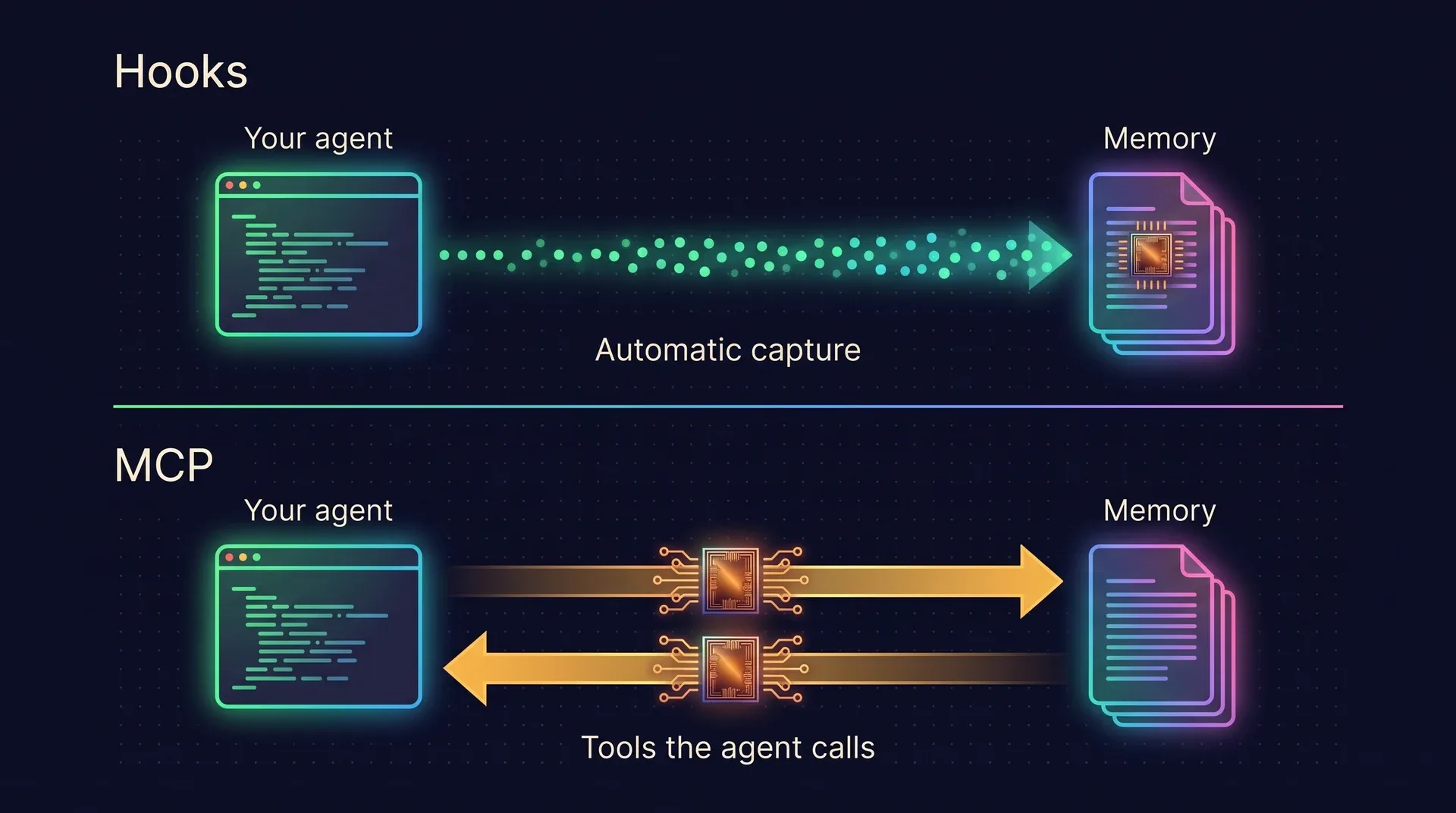
Hooks capture, MCP answers
These are two separate connections, and a fully supported agent has both. The status labels above say which ones your agent gets.
Hooks
The agent’s lifecycle events fire a small command that records prompts, tool calls and session boundaries. You do nothing, and the agent spends no tokens on it. Secrets are stripped before anything is stored.
MCP
The agent gets memory tools it can call when the conversation needs them: search, read a page, write a page, accept a handoff. MCP-only agents can use memory fully, but nothing is captured unless they write it.
Let Claude Code run alone, inside a sandbox
Even with --dangerously-skip-permissions, Claude Code keeps asking, so someone sits and babysits it. Switching every prompt off is a real risk. ai-memory run --yolo names what it is about to disarm, and when ai-jail is usable it offers to re-run the session inside it. --true-yolo adds Claude Code’s bypass mode on top; your own ask rules and its command-safety checks still apply.
The warning says what changes
No prompt means the agent can delete files, run any command and reach the network. You read that before you say yes.
ai-jail boxes the session in
bubblewrap with Landlock and seccomp on Linux, sandbox-exec on macOS. Say yes and a checklist picks which host credentials the jail gets. Say no and the session still runs, outside the box.
Only a person is asked
The questions appear on a real terminal. Hooks, CI, detached and piped runs are never interrupted, and a session already inside ai-jail is not asked twice.
❯ ai-memory run --true-yolo claudeINFO ai_memory_cli: ai-memory starting version="2.6.5" bind=127.0.0.1:49374⚠ --yolo runs every tool call with no confirmation. An agent can delete files, run any command, and reach the network unsupervised.Proceed? [Y/n] yai-jail is installed. Re-run this session inside it? [Y/n] y
Linux or macOS with ai-jail installed. --jail goes straight in with sensible defaults and needs no --yolo; --no-jail keeps the warning and skips the offer.
Operating systems
One Rust binary per platform. On Windows, WSL2 is the supported path and the native build is experimental.
| Platform | Status | How it installs | Notes |
|---|---|---|---|
| Linux | Supported | Release tarball, Docker or Podman image, an AUR package or a Fedora RPM | x86_64 and ARM64. Native binary, Docker or Podman, AUR packages with systemd units. |
| macOS | Supported | Release tarball with a launchd agent, Docker, or the menu bar app built from source | Apple Silicon and Intel. Native binary with a launchd agent, Docker, or a menu bar app you build from source. |
| Windows via WSL2 | Supported | The Linux binary, inside WSL2 | Follow the Linux path inside WSL2 and launch your agent from there. |
| Native Windows | Experimental | Release zip, Docker Desktop wrapper, or a source build | Release zip with ai-memory.exe, the Docker Desktop wrapper, or a source build. The zip upgrades itself with ai-memory upgrade. |
| NixOS | Supported | Flake package, or the NixOS module as a system service | Flake package and a NixOS module with a hardened systemd unit. Secrets through agenix, sops-nix or an environment file. |
LLM and embedding providers
Both are optional. With neither, hooks still capture, search still works, and every session still ends with a summary page and a handoff.
Embeddings: local by default
Since 2.0, vector search runs in-process with a small open model. It needs no API key and no GPU. The model is about 87 MB, downloads in the background on first start, and hybrid search turns on at the next restart. If the download fails, search keeps working on full text.
- Local, in-process (the default)
- OpenAI
- Voyage
- Google Gemini
- GitHub Copilot
- Ollama, LM Studio, vLLM
Opt out with embedding_provider = "none". A provider you configured yourself is never overridden.
LLM: off by default
Add one when you want LLM-written consolidation, ai-memory bootstrap, richer linting, auto-improve or reranking. A small, fast model is the right size for this work, where the provider lets you pick one. With a Codex or ChatGPT login, keep the provider’s default model, because that backend rejects other model names. Subscription logins work, so a paid platform API key is not required.
- Anthropic
- Anthropic OAuth (Claude subscription tokens currently refused for third-party apps)
- OpenAI
- OpenAI OAuth / Codex CLI login
- GitHub Copilot
- Google Gemini
- OpenCode Go and Zen
- Ollama
- LM Studio
- vLLM
- OpenRouter and any OpenAI-compatible endpoint
Check a provider with ai-memory llm-test. Fallback chains are supported.
Models, defaults and costs are in the LLM providers guide and the local embeddings guide.
Your agent is not listed?
Anything that speaks MCP can use the memory tools today.
Register a remote HTTP MCP server at this address in your agent’s settings. Search, page reads and writes, and handoffs all work. Automatic capture needs lifecycle hooks, so without them the agent only remembers what it writes.
Want full support for it? The managed-harness contribution guide describes what an adapter has to prove, and the contribute page says where issues and pull requests go.
# the default local server
http://127.0.0.1:49374/mcp
Questions and answers
Which coding agents does ai-memory work with?
27 agents and editors are listed, including Claude Code, Codex, Cursor, Gemini CLI, OpenCode. 20 of them have both automatic capture through lifecycle hooks and the memory tools over MCP.
What is the difference between hooks and MCP?
Hooks capture sessions automatically: prompts, tool calls and session boundaries are recorded without the agent doing anything. MCP gives the agent tools it can call to search and write memory. A fully supported agent has both.
My agent is not listed. Can I still use it?
Yes, if it speaks MCP. Point it at http://127.0.0.1:49374/mcp and it can search and write memory. Without lifecycle hooks, nothing is captured automatically.
Do I need an LLM or an embedding provider?
No. Both are optional. Since 2.0 the default embeddings run in-process with a model of about 87 MB that downloads on first start, and no API key is involved.
Does ai-memory run on Windows?
Yes. WSL2 is supported through the Linux path. Native Windows is experimental and ships as a release zip with ai-memory.exe.
Give your agents a memory today.
Free and open source under the MIT license. You need no account and no API key.